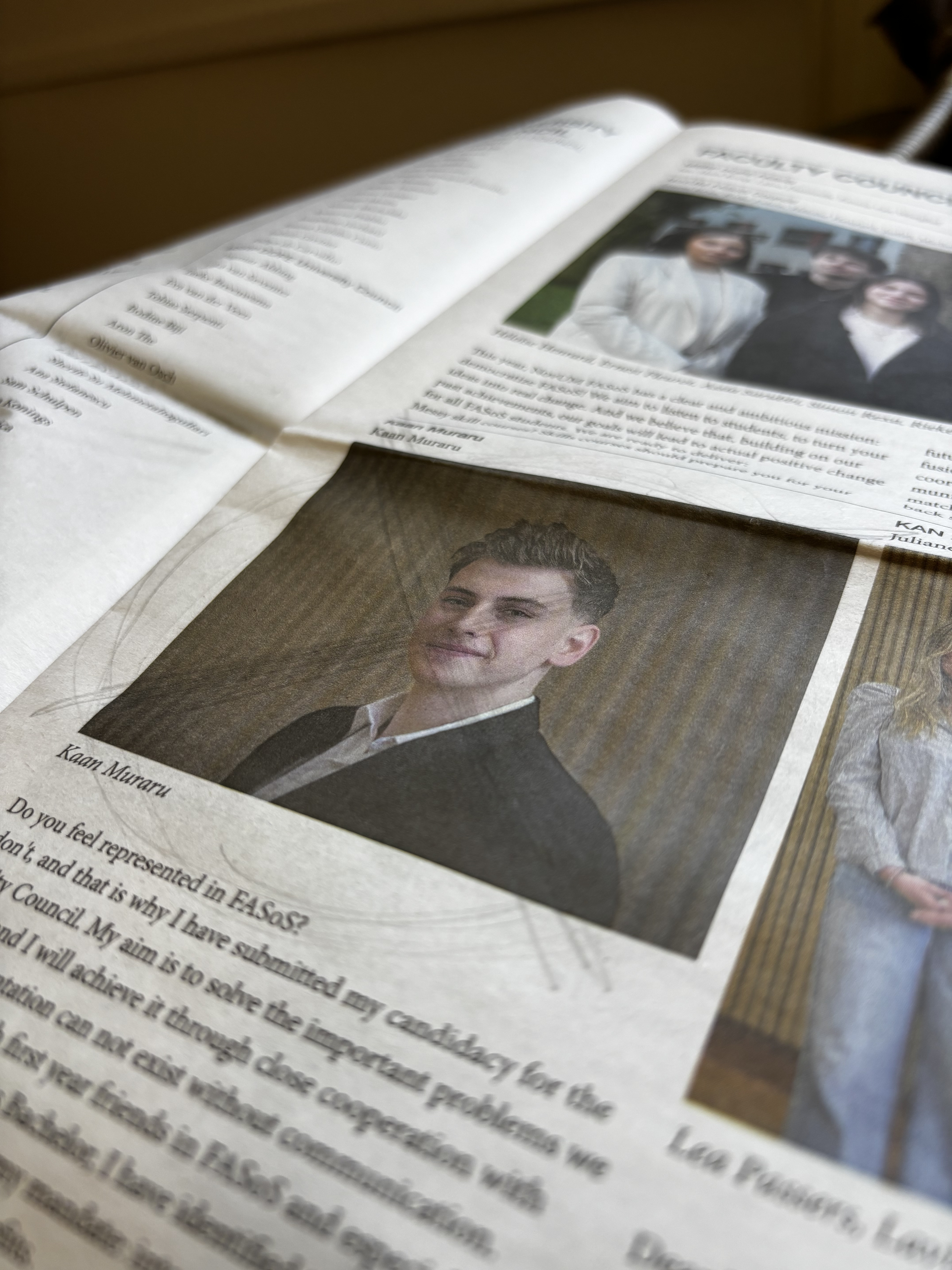
"You Kaan do it!" "We subscribe to Kaanism" "Good luck" "Equal opportunities for all students!"
These were just some of the messages I collected on my 'memory board' during my 4 day campaign for a seat in the FASoS faculty council. Bachelor students, masters' students, Professors, tutors, even Banditos, were all happy to leave an ink testament.
I campaigned with the epic budget of 40€. Three A2 cardboard papers (6€), 2 big permanent markers (16€), scotch tape (5€), and three colourful markers my good friend and neighbour Maëlys gifted me back in October. With the rest of the money I fuelled Mr. Table with two soups and three ginger tees.
You would think that this funny attempt at calling a days worth of working at ALDI a campaign budget, did absolutely nothing against the other three established, Goliath parties. Well, I (and mister table of course) defeated all candidates but one, winning over 12% of the electorate. The other candidate - which I will not name, because I already got into legal troubles - had three more votes.
After I posted the excel tables with the result, I got about 20 of my friends texting me excitingly: "Congrats on the win man! You killed it!". They melted my heart, for which I will forever be thankful, but sadly the win was only spiritual.
Maastricht University uses the Dutch parliamentary system for elections. The Dutch electoral system is one of the most representative in the World. There are 150 seats in the Dutch Parliament and a small party ,or independent candidate, only needs about 0.67% of the votes to get a seat. At FASoS you need 20% of the votes to get a seat, for University Council you need 10%. Sounds representative? At the result ceremony, Mr. Teun Dekker, professor and chairman of the university council took some 15 minutes of his time to explain the results to me with mathematics. I also did mathematics and informatics in high school and I understood finally. Thank you Mister Dekker for your time.
This understanding that the system massively favourites big parties, when it shouldn't, crushed my soul, but also motivated me to write and fight for change. It is very important to quickly fix the electoral system for both the university and the students. With a lower turnout than last year, UM elections are getting less and less popular, it is a waste. I found two core problems to this system, which I will list below.
- Number of seats.
The whole idea of representativeness that the Dutch electoral system employs, turns into a mathematical villain. Because of the very low number of seats, the effect is completely reversed, and big parties are masively favourised. This is why (please don't sue me over this sentence) a certain party which I will not name for legal reasons, has 0 seats in Limburg, 2 seats in Maastricht, 3 seats in the Dutch parliament, but amazingly, 8 seats across University and Faculty Councils at UM. Regardless of how bad these numbers look, mathematics and common sense tells us that it is easier to get a seat in the Dutch parliament than at UM. At the end of the day, it is much easier to meet a 0.67% threshold than a 20% one, right? Well, judging by the numbers above and the next reason, it is not that straight forward.
- Big party tactics.
I will shortly explain the two tactics I consider as 'unsportsmanlike', big parties have employed this year.
a) Candidate 'spammers'
In party terminology, this is called 'list pushing'. Across all faculty councils there were 20 lists, 13 of them had more candidates than seats in the council. I believe that this is extremely unfair to the candidates that don't hold a top position on the list. Even though these matters are settled within the party, this type of 'list pushing' should not be allowed. The most voted candidates should get the seats, it should be a regulation.
In the University Council, a seat was won with 71 votes. That is 1.55% percent of 4576 votes. This year, an independent candidate under the list name "Seat for Students" also campaigned. It got 244 votes, it did not get elected. This case is absolutely tragic!
At FASoS one in 8 students are not accounted for in the council. One in 8 students voted an independent that was not elected.
We should protect independent initiatives!
b) Flyer spamming
Building managers this year tried banning the erratic spread of fliers but to no avail. I do not even have to explain how annoying they are. Flyers are unsustainable and trash campaigning spaces. A human that cares about the environment, will not spread hundreds of paper wasting flyers.
Regardless, UM elections can still be saved, without raising the number of seats. After conducting my research for this article, I found two solutions. First, would be a complete system change, where the university implements a voting system of 'simple consecutive majority'. Basically, the 10,9,6 or 5 most voted candidates win the seats. This change will make the race much more interesting, popular, and fun. Second, minimising the number of candidates on a list to the number of available seats. This change would stimulate both parties and independents, to come up with competent programmes and people. Such changes will make University politics much more popular and fun.
Because "you have to be the change you want in this World", I started a petition to modify the system. The link is below, if you feel like what I wrote is truly important:
https://gjbp0wkh.forms.app/petition-change-um-election-system-university-and-faculty-councils
Please send any comments, remarks or opinions at this email: k.muraru@student.maastrichtuniversity.nl , I really need your feedback. You can also text me on any of my socials.
P.S.1: Student council positions are paid!
P.S.2: The link to the PUBLIC results below: https://www.maastrichtuniversity.nl/about-um/organisation/participation-representation/elections
Sources:
https://www.maastrichtuniversity.nl/news/councillor-vanessa-lapointe-‘you-dont-have-be-seasoned-politician-join-university-council’
https://elections.maastrichtuniversity.nl
https://www.maastrichtuniversity.nl/about-um/organisation/participation-representation/elections
https://www.maastrichtuniversity.nl/studeren/studentenleven/student-organisations